
 Device Online Login








Advancing Lung Care Through Robotic Bronchoscopy with Dr Nick Wilsmore and Dr Barton Jennings
At Device Technologies, our Robotics team is passionate about supporting healthcare professionals with new and leading technologies in the aim to improve patient outcomes across the globe. In recognition of Lung Health Awareness Month this May, we spoke with Victorian Interventional Pulmonologists Dr Nick Wilsmore and Dr Barton Jennings about their journey with robotic bronchoscopy, and how they see the technology supporting patients through their care pathway.

Before adopting robotic bronchoscopy, what were the main challenges you faced with the conventional diagnostic pathway? What initially drew you to robotic bronchoscopy?
Nick: For me, it has been a long journey - we used traditional methods for many years, such as radial EBUS and cone-beam CT, which both brought many limitations and difficulties in accurately diagnosing patients with lung health conditions. I take pride in providing answers to patients, so finding and giving accurate diagnoses are extremely important to me. This is why I began exploring robotic bronchoscopy as an option - it took away many of the complexities and improved both navigation and consistency in the process, which I had been missing in the traditional methods, and it's ultimately what drew me into the robotics space.
Barton: My main clinical interests have always been advanced bronchoscopy and the diagnosis of lung conditions. I've been doing high-volume bronchoscopy for over a decade, using linear and radial EBUS, as well as electromagnetic navigation (EMN). Although this system provided some benefits, it was complex, required multiple operators, and didn't improve yield enough to justify continued use. Shape-sensing robotic bronchoscopy is different - it significantly helps improve diagnostic accuracy while still being manageable for a single operator. This technology fits perfectly with my clinical focus, so I was very keen to adopt it to better support patients.
How have robotic bronchoscopy technologies changed your ability to navigate complex airway anatomies?
Nick: Shape-sensing robotic technology helps reduce much of the mental burden of mapping the airways and makes navigation far more intuitive. The biggest difference, though, is the technology's catheter stability, which translates to better accuracy now and opens the door to future therapeutic work through the airway.
Barton: The navigation seems far more reliable and intuitive compared with other systems I've used in the past. Shape-sensing eliminates many of the issues we used to have, such as CT-to-body divergence, especially in the periphery. You don't need awkward positioning boards, registration is quick, and the system consistently matches what you see on imaging with what you experience anatomically.
Since beginning the robotic bronchoscopy pathway, have you seen improvements in how patients move through their care journey?
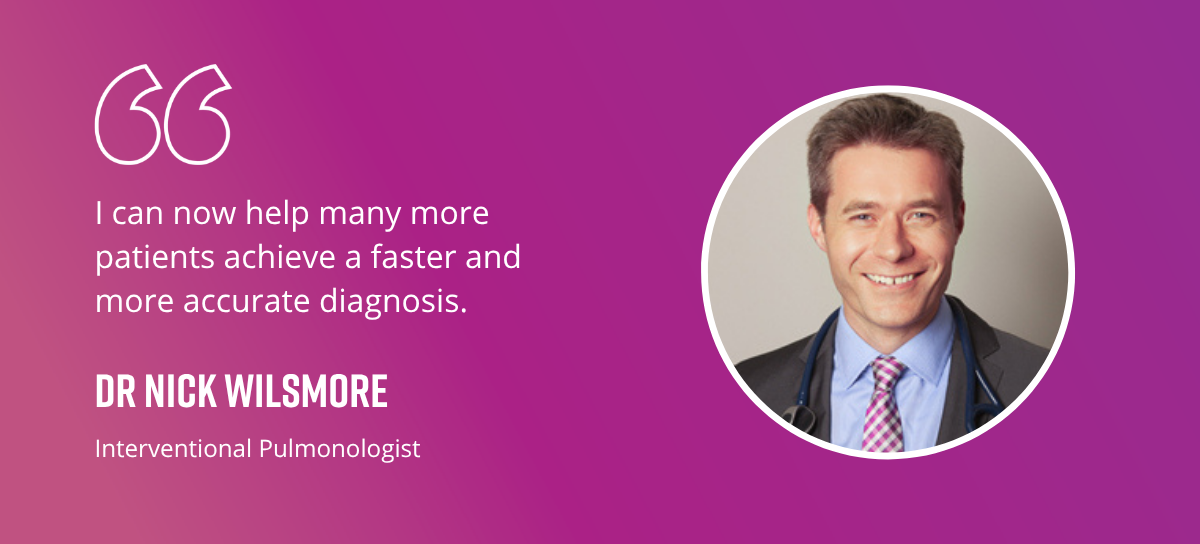
Nick: Absolutely. Before, there were many patients I simply couldn’t provide services to because I knew the chances of getting a result were low. Others were placed into surveillance pathways, which often meant months of waiting for repeat CT scans. And in some cases, people even went straight to surgery without a confirmed diagnosis. Since adopting robotic bronchoscopy technology, the pathway has changed completely. I can now help many more patients achieve a faster and more accurate diagnosis, leading to better outcomes.
Barton: Absolutely - robotic bronchoscopy technology allows us to assess small or hard-to-reach areas, helping guide our next steps. With easier navigation, we can involve other specialists earlier in the process to determine exactly what is needed for the patient. In more complex cases, such as very small or less-defined areas, even if a clear result isn’t possible straight away, reaching the location in the lung and placing a marker can help ensure the next step moves forward more smoothly.
What did your implementation journey look like, from interest to first procedure?
Nick: The whole implementation process was actually very smooth. I’d already spent close to two decades working through standard bronchoscopy, then moving into radial EBUS, and later cone-beam CT, so by the time robotic bronchoscopy became available, it felt like a natural next step rather than a big leap.
What surprised me was that the learning curve for the robot was much easier than the earlier technologies I’d mastered. Radial EBUS and cone-beam both required far more time and mental energy to get truly comfortable with. Robotics, by comparison, was intuitive, stable, and far more straightforward to adopt, which made the transition incredibly seamless.
Barton: When I learned that Australian hospitals were beginning to use shape-sensing robotic bronchoscopy technology, I was very keen to be involved. I travelled to the U.S., visiting centres in California and San Diego, and had dedicated training both in hospitals and a lab, which was incredibly valuable. For my first list of cases, I had an experienced colleague from Queensland with me, which provided great guidance and confidence. Since then, I’ve maintained close collegial support with him, discussing difficult cases and reviewing CTs together. That peer-to-peer connection has been fantastic, especially in the early stages of building experience.

How has robotic bronchoscopy influenced collaboration between interventional pulmonology, thoracic surgery, and radiology?
Nick: Robotic bronchoscopy has strengthened collaboration across the whole team. Surgeons and radiology colleagues are now able to plan and act earlier, and the team has more confidence when guiding procedures. It’s also opened up opportunities for cases that were previously considered challenging, creating a noticeable shift in how patients are referred and managed.
Barton: Robotic bronchoscopy has brought the team together earlier in the process. Rather than working in isolation, we can plan next steps with clinical teams ahead of time, making care more coordinated. It also opens opportunities to combine steps in selected cases, improving efficiency and patient experience.
What advice would you give healthcare professionals and hospitals looking to implement robotic technologies into their procedures?
Nick: Right now, in many hospitals, patients with lung health conditions may go through several different procedures and might end up without a diagnosis. That’s not ideal for the patient, and it can expose them to unnecessary risk and delays.
Robotic bronchoscopy has the potential to streamline that journey. When we can diagnose earlier and more accurately, patients get staged appropriately and start treatment sooner, which naturally leads to better outcomes. The other big piece is data - collecting it, auditing it, learning from it. Staying aligned with evolving international guidelines helps us understand which patients are best served by the robot.